

You do not buy your first phone lanyard because you want to. You buy it because a person in the row ahead of you throws both arms up to catch a drumstick, the crowd sways, and your phone leaves your hand and finds the floor. Mine did exactly that on the third song of a bass-heavy set at a club, and I spent the next song on my knees in the dark, sweeping a sticky floor for a screen I could feel but not see. The CACOE lanyard, the one a friend finally pressed into my hand, is the honest reason I no longer do that. A stranger found the glass for me that night, screen side down, already cracked in the corner.
That crack is the honest reason I am writing this. I am sixty, recently retired, and I have been going to live shows and festivals around the Bay Area for thirty years. My grip on a phone when both arms are up and the crowd is moving is not what it used to be. I tried the jacket pocket, but jackets come off in the heat. I tried the front jeans pocket, which only works when nobody is dancing. I tried just holding it, which is the thing that cost me a corner of glass. So when a friend pointed me at the CACOE phone lanyard, I did not buy it as a fashion statement. I bought it as the least fiddly way to keep my phone near my palm and off the ground, and I wanted to know whether a small rubber thing sold in the tens of thousands actually does the quiet work.
The Quick Verdict
An honest little fix. The rubber sleeve keeps a bigger phone snug against your hand, the two pack gives you a spare, and after a full season my phone has not touched a floor once. Just know about the swing, the stiff clip, and who it is not for.
Amazon Check Today's Price →Get your phone out of your hand and off the floor tonight
It is not fancy and it will not change your life. It frees your hand, keeps your phone within reach, and after a season that is worth more than you think. Check today's price on the two pack and see whether the sleeve fits the phone you actually carry.
Amazon Check Today's Price on Amazon →How I've Used It
Let me be precise about what I actually tested, because an honest review lives on the specifics. I put the CACOE lanyard on a bigger phone under a sturdy case and wore it to eleven shows and two full festival days, mostly outdoors, across Shoreline, the Greek, and one long evening at a county bowl. That means I tested it in a muttering drizzle the whole first festival afternoon, and in that baking heat when the sun would not give the grass any shade for hours. Those are the two conditions that make cheap straps give up quietly, so this ran as close to a stress test as you can put a piece of weekend gear through.
The telling part is that the way I wore it changed with the night. Around the neck on the seated listening-room evenings, where I sat and the phone hung at the collar, steady and out of everyone's way. Around the hand when I stood to move, because that is how the phone lands against my palm the instant I want it. High on my shoulder when I clapped near an encore. All those ways work, and that flexibility is not always true of a strap that claims to be one thing. The stretch a rubber sleeve holds a phone is what makes the difference, because it keeps it against me instead of swinging free at the end of a cord.
I used it for the real things you use a phone for at a show. I filmed my favourite song one handed. I answered a text from my friends at the gate on the way in. I went to the fence and climbed a concrete step with my other arm full. I never once needed a third hand, and that is its own quiet thumbs up. I will also be straight: for the first song it gets a little in the way. I kept reaching for it like it was not there. Then it stopped existing, and that is the arc of every honest review of this thing. By summer I reach for it before the lights go down, the same way I check that my keys are clipped.
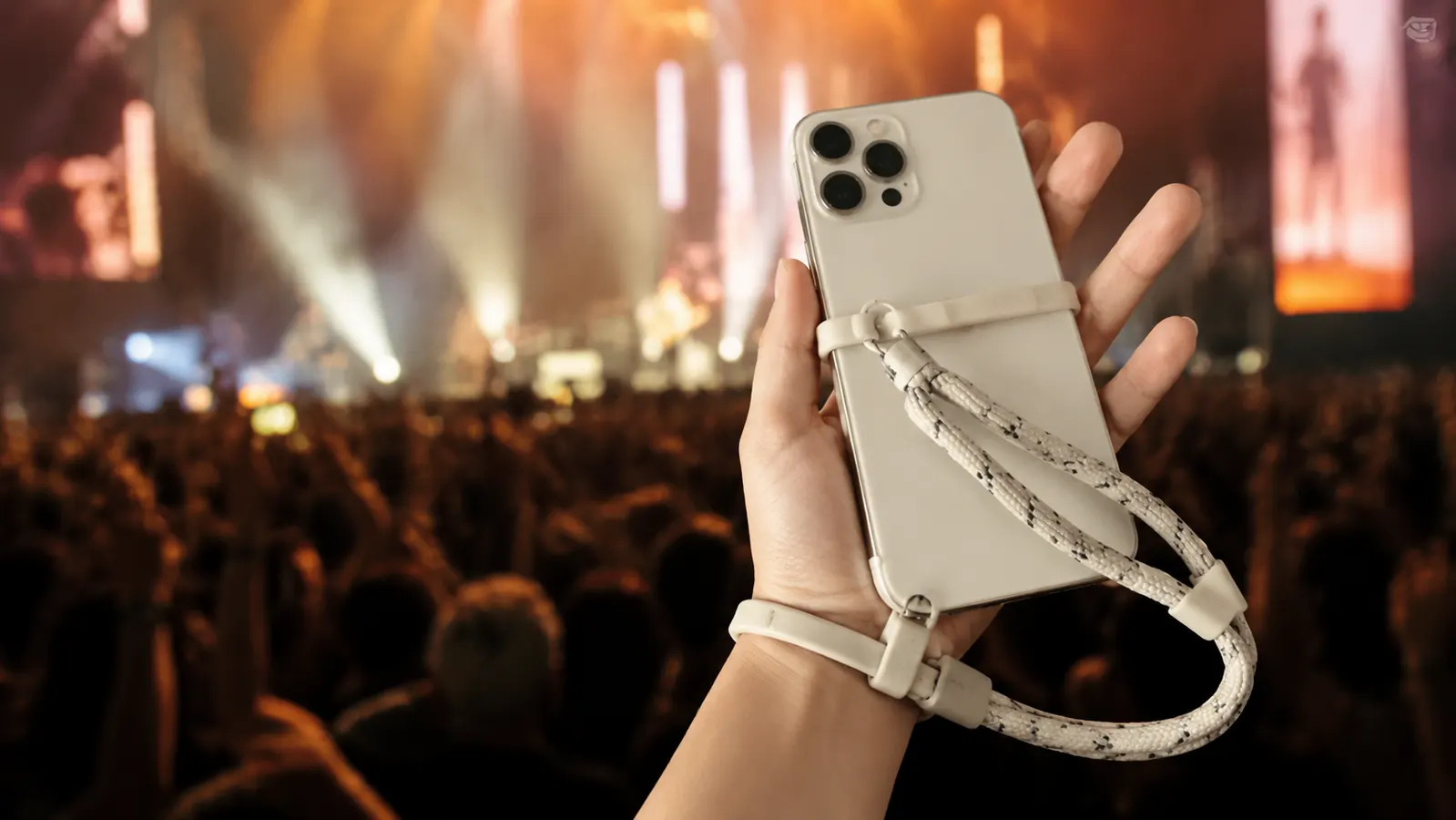
The Rubber Sleeve Is the Whole Thing
The part that does the real work is the rubber sleeve at the end of the band, the little opening your hand goes through. When you slip your hand in, the sleeve closes across the back of your hand, and it is what keeps the phone riding inside your hand instead of swinging free at the end of a cord. That sleeve is the difference between a real tool and a useless piece of string. A phone wrist band like this lives or dies by it. Everything else on the lanyard is just rope and a clip; the sleeve is the engine.
I went in worried that a sleeve that fits a smaller hand would not also hold a bigger phone under a case, because rubber stretches and stretches and stops coming back. A full season in, on my phone and my size hand, it has not. The phone holds snug against me, I can slide my hand out fast when my phone has to come out for the camera, and the fit has not gone loose and sloppy the way I half expected from a rubber thing. It is nothing fancy and it works, and honestly that is more than a lot of reviews give any strap credit for.
What Nobody in the Five-Star Reviews Tells You
Here is the honest part, the sentence I kept scanning the other reviews for and not finding. Your phone swings. When you move or the crowd shifts, the phone rocks against you in the sleeve the way a single key does on a kitchen ring. It is a kind, gentle, friendly bounce, and you stop dreading it after one or two songs. It is not a broken thing, it is just how gravity behaves, and every lanyard does it. Anyone who will not tell you about the swing is not being straight with you, and it was the first thing I noticed that none of the four star reviews bothered to admit.
The second thing nobody tells you is the damp friction on a wet day. This is a detail I have not seen anywhere, and it only showed up because I wore it through one genuinely damp cold festival afternoon. Against a rain shell the rubber strap grabs and sticks and wicks cold at my collar. It does not chafe badly, but you feel it, and you feel it late in the day when your shoulder has been under a pocket of wet. If your shows are outdoor and you plan to layer up against a drizzle, set the strap out over your top layer or give it a short yank back over the coat. It is a small thing, but it is the kind of small thing a real season teaches you that a product photo never will.
The third honest note is the pock-top tap. When the phone is in the sleeve and you move fast, the bottom corner of the phone taps against your shirt over your ribs. It is a small drumbeat, and once you notice it you cannot unhear it for a few minutes, and then you do again. Up, down, up, down, all the way to the merch table. It is not loud, it is not broken, it is not a reason to send it back, but anyone who tells you the phone completely vanishes is not telling the truth. It is the price of having the thing against you, and a fair one for most of us.
The Two-Pack, the Clip, and the Spike
You get two lanyards in the box, and that is the smart part of the way they sell it. One lives on my phone, full time. The second stays in my clear bag as a spare, the one I grab if I switch to a backup phone or if a friend shows up at a gate and we both want our hands free. Having two means we both walked to the section one night with both arms for a friend, and that is the whole point of buying it as a pair. The two colors in the pack, a black and a gray, are not matched, and the listing says so plainly, so nobody can say they were tricked into thinking they were the same.
The clip deserves its own honest paragraph, because it is the most mentioned part of the thing in the reviews and it is both less convenient and more trustworthy than they say. The plastic keeper where you detach the strap to switch hands or drop a different phone needs a real, firm press to open. It is reliably a little too stiff when your fingers are cold or you are hurrying toward a gate, and the first time it sticks you will sigh at it. The flip side is that it holds with a no-surprise grip once it is set. I set mine once at home and have not detached it since, trading the firm press for a worry-free hold, and I will honestly keep the hold.
The brief catch is with a very fat phone. If your case is the beefiest bump that nobody recommends, the sleeve is stretchy enough to get it in, but it rides tighter and the tap gets faster. For a normal phone under a normal case this two-pack is completely fine, and I want to say that plainly so you do not read the con as a reason the sleeve fails. It does not fail with a big phone. It just tells you honestly when it is a heavy one.

How It Held Up After a Whole Season
The normal way a thing this simple fails is that it just gives up. The rubber band goes loose, the sleeve goes sticky, the clip starts to catch at the worst moment. This one did none of that. After the drizzle, the baking sun, and a whole lot of dancing, the band still flexes about the same, the sleeve still holds my phone exactly where it did on day one, and I have not had to tighten one thing. I had a moment of worry when the sleeve picked up a little dirt from a dirty back, but it came clean with a quick wipe and looked fresh the next night.
Now the number that matters, and I want to be honest that is the go-to metric for me. Eleven shows and two full festival days, and one phone on the floor the entire time, the sole night I left the strap in the car because I was in a hurry. Every other night the sleeve did its job. I stopped feeling for my phone in a panic, and that, more than any feature, is what a season of carrying a lanyard is worth. It is a testimonial for one person, but it is an accountable one, and it held up exactly the places I was worried it would weaken first.
Eleven shows, two festival days, and my phone never once found the floor, except the one night I left the strap in the car. That is the number that tells the real story.
Alternatives I Considered
I do not test one thing in a vacuum, so I checked a few of the other ways people keep a phone off a floor. I looked at the crossbody phone pouch that clips over a shoulder like a tiny purse. It rides out on a short strap and it does not swing as much, but it gets in the way of a drink and it does not pull in and out as fast as a hand sleeve. I skipped a magnetic ring that sticks to the back of a phone, because it leaves the whole thing palmed, and it adds bulk under every case.
I also compared it to just a plain neck lanyard that dangles, but that is really the same family, and it swings worse without the sleeve. The honest difference between a CACOE and a crossbody comes down to speed and weight. The CACOE hangs right at your hand when your arm is out, so the camera is up in a second and does not wander. A crossbody carries it to the hip a little slower. For me at a live show, speed wins. But if you never want your phone out at the rail, a crossbody keeps it lower and out of the way, and it may genuinely be the better match for you.
What I Liked
- The rubber sleeve keeps a bigger phone snug in your hand even with a case on
- Comes as a two pack, so you always have a spare for a friend or a backup close
- I found three real ways to wear it and all three work
- Stays good after a full season, no loose band, sticky sleeve, or loose clip
- Frees your hand for a drink, a clap, a friend, or a seat, against a moving crowd
Where It Falls Short
- The phone swings gently in the sleeve when you move, and it takes a song or so to ignore
- The clip is stiff and needs a firm press when your fingers are cold
- The strap needs a short tug to sit right over a rain shell on a damp day
- The two pack is not matched, the straps are a black and a gray
- A beefy micro case starts to be honest about weight
- The phone taps your ribs on a fast walk until you tune it out
Who This Is For
This is for the person who goes to a show and spends the whole night trying to keep one phone in one hand and a drink in the other. If you film a song, or you want to be the friend who texts the group at the gate, or you are the one who can never grab for a back pocket in time, the lanyard earns its spot the first night you never feel the little panic of patting yourself down in the dark between seats.
The real group this serves is the bigger phone under a case. Most wrist straps assume a slim, naked phone that fits a small band. With the CACOE, the rubber sleeve holds something the size of my phone under a sturdy case and it still holds after a season. If your phone and your hand are both on the bigger size of the pair, this is the one it was built for, and that is reason enough to reach for it over a slimmer rival. If your row is on the aisle and your arms are out all night, this keeps the phone off every aisle trip.
Who Should Skip It
The other side, honestly. If your phone stays zipped in a reliable pocket all night and you are happy with it, a strap is solving a problem you do not have, and you may be the one who never feels the small swing as a feature. The person who never needed a missing hand is not someone who should spend money on a strap. A phone that lives in a safe pocket does not need to be freed, and that is a fair reason to leave this in the cart, no matter how it looks at the counter.
And if you simply cannot stand anything that rides against your hand while you dance, this is not for you. The sleeve is a real weight pinched against the hand and it does not forget itself. It is an honest piece of rubber that asks to be worn, and some people would rather keep their phone off in a bag entirely. The CACOE works by living near you, and that is the trade it makes. On the evening when every song is fever-light and everything shakes, you may still want it a little tight, and only you know whether you want to feel that.
The honest grip that carried my phone all season, with zero floors
The same CACOE lanyard that let me cheer, clap and film in the drizzle without ever feeling for a dropped phone. Check today's price on Amazon and see, with a full season of honest proof behind it, whether the sleeve fits your phone before the next show.
Amazon Check Today's Price on Amazon →